
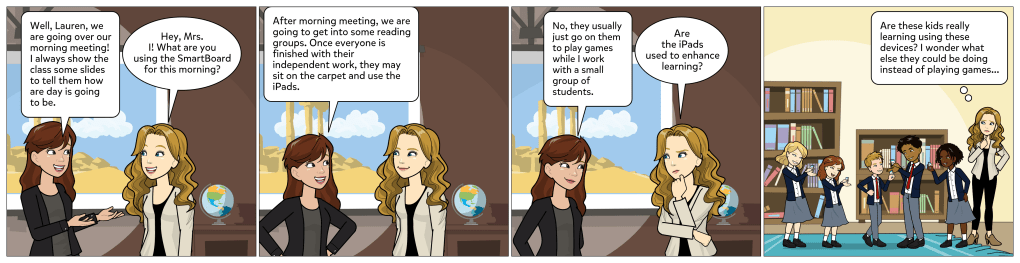
This comic specifically shows the two relationships that my first graders have with technology in our classroom. My mentor teacher spends a lot of time in the front of the classroom at the SmartBoard, showing our students videos, morning meeting slides, or pictures of things. She also uses our ELMO projector to model worksheets or to demonstrate how to do something. According to Martin, there are four pedological functions: connection, translation, off-loading, and monitoring. For connection, my teacher chooses to display information on the SmartBoard so that everyone can see. If she modeled a worksheet on the whiteboard, no one would be able to see what she’s doing and they would become very lost and confused. For translation, sometimes my teacher will show a video, such as a BrainPop Jr., to explain an idea or concept. She used one about the Constitution so that our students could listen and visualize what the constitution is. When it comes to off-loading, this is where the use of the iPads comes in. We usually do independent reading and math groups. My teacher gives everyone a worksheet to complete, but sometimes the higher level kids get finished first.
While my teacher is working with the lower reading or math groups, students are able to go on the iPads in the classroom. There are only five of them, but some of our students will share. However, students are playing educational games on these iPads, so they aren’t really used to enhance the concepts of the lesson that was just taught. When independent reading and math groups occur, my teacher is solely focused on the small group she is working with, so she doesn’t really monitor the kids on the iPads. For example, one day we were in small group and someone yelled very loudly something regarding the game Candy Crush. Two students were playing that game and my teacher and I didn’t even know it was happening. We immediately deleted the game off of all the iPads, but we didn’t even know what was occurring at that point in time. St. Dominic uses a program called IXL for both reading and math, so I feel like during independent time, students could work on that instead of playing games. We can track their progress online to see what they are doing, and when they log in and out.
Because my teacher is very old school, she likes to use lots of pencil and paper in class. Although using pencil and paper is not something we would consider technology, I do believe that this helps with my definition of distributed cognition. According to Menary, “We create and manipulate words and sentences in conjunction with relevant bodily and neural functions” (2007). This reminded me of the gears example we talked about in class. Students have to think about the words they want to write down using a writing instrument. They put their thoughts into words and put their words onto paper to make meaning. Based on how my observations went and how my teacher teaches her class, this is what I would think distributed cognition means in this type of context.

 ED 386 Educational Technology - Lauren's Blog